Thursday, December 9, 2010

Module 15

Module 15:
Go Ask Alice

Summary: This diary tells the story of an unnamed narrator who goes from a lonely, insecure teenager to a young girl hooked on drugs and the consequences that come with those kinds of decisions.

Citation:
Anynomous. (2006). Go ask alice. New York: Simon Pulse.

Impressions:
It was an interesting book to read and it was interesting to read about all of the controversy as to whether or not the diary was real or fictional. Thousands of teenagers go through a similar spiral in their lives everyday and it is good to be aware of such a problem.

Review:
Amazon.com Review
The torture and hell of adolescence has rarely been captured as clearly as it is in this classic diary by an anonymous, addicted teen. Lonely, awkward, and under extreme pressure from her "perfect" parents, "Anonymous" swings madly between optimism and despair. When one of her new friends spikes her drink with LSD, this diarist begins a frightening journey into darkness. The drugs take the edge off her loneliness and self-hate, but they also turn her life into a nightmare of exalting highs and excruciating lows. Although there is still some question as to whether this diary is real or fictional, there is no question that it has made a profound impact on millions of readers during the more than 25 years it has been in print. Despite a few dated references to hippies and some expired slang, Go Ask Alice still offers a jolting chronicle of a teenager's life spinning out of control. (Retrieved from http://www.amazon.com/Go-Ask-Alice/dp/1416914633/ref=sr_1_1?s=books&ie=UTF8&qid=1291958023&sr=1-1)

Suggestions:
Although this book has often been subject to controversy and many have tried to ban it for various reasons, I still believe that it is an excellent book that shows that there are negative consequences for drug use. The book is filled with sex, drug abuse and most parents don’t agree with how the narrator is constantly disobeying their parents.


Module 14

Module 14:
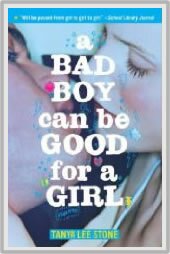
A Bad Boy Can Be Good for a Girl

Summary: Each chapter in this book in verse is told in a different perspective of a teenage girl who are all involved with the same boy at one time or another. Josie, Nicolette and Aviva all fall in love with the same boy in school. He seems to be after only one thing and the story tells the tale of the three girls and what they sacrifice for the love of a boy.

Citation:
Stone, T. (2006). A bad boy can be good for a girl. New York: Wendy Lamb.

Impressions:
I thought this was an excellent book and a very quick read. I read the entire book in about an hour because it was such an interesting book. The alternating point of view made it even more interesting and open to different girls of all ages who may find themselves in similar situations.

Review:
From School Library Journal
Starred Review. Grade 9 Up–Three girls succumb to the charms of one sexy high school senior and emerge wiser for the experience in this energetic novel in verse. Josie is a self-assured freshman who values her girlfriends over boys until a hot jock focuses his attention on her and her simmering hormones break into a full boil. Confused by her behavior, yet unable to control her desire, she acts out every romantic cliché she has ever disdained, until the boy drops her and she experiences the chill of rejection. It is Judy Blume's Forever that sparks Josie's fire again, and finding a few blank pages at the back of the library's copy, she sends a warning to the girls of her school. Next readers meet Nicolette, a junior who sees her sexuality as power. A loner, she's caught by surprise at her own reaction when this popular boy takes notice of her. Suddenly she thinks she sees the difference between sex and love, and then, just as suddenly, he's gone. Finally, Aviva, a pretty, smart, artsy, and funny senior, is stunned when the jock seems to want her. She gives up her virginity, only to be disappointed in both the sex and the boy. Furious, Aviva heads to the library to check out Forever, now crammed with the words of girls who suffered the same fate at the hands of the same boy. The free verse gives the stories a breathless, natural flow and changes tone with each narrator. The language is realistic and frank, and, while not graphic, it is filled with descriptions of the teens and their sexuality. This is not a book that will sit quietly on any shelf; it will be passed from girl to girl to girl.–Susan Oliver, Tampa-Hillsborough Public Library System, FL (Retrieved from http://www.amazon.com/Bad-Boy-Can-Good-Girl/dp/0553495097/ref=sr_1_1?ie=UTF8&qid=1291957934&sr=8-1)

Suggestions:
This book could be quite controversial for various reasons considering that the majority of book is filled with very mature themes such as mature relationships and sex.


Module 13

Module 13:
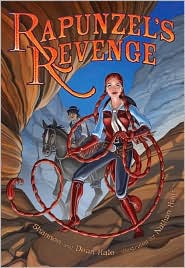
Rapunzel’s Revenge

Summary:
This fairy tale with a twist tells the story of the long haired young woman named Rapunzel and the adventure she begins when she discovers the truth of her mother. She, then, goes on a search for a way to save her real mother and the entire kingdom.

Citation:
Hale, S., Hale, D. (2008). Rapunzel's revenge. New York, NY: Bloomsbury.

Impressions:
I enjoyed reading Rapunzel’s Revenge very much. I love alternate versions of classic fairy tales such as Rapunzel. Rapunzel was a strong, female character who saved herself from the tower instead of the typical “handsome prince.”

Review:
This graphic novel retelling of the fairy-tale classic, set in a swashbuckling Wild West, puts action first and features some serious girl power in its spunky and strong heroine. Young Rapunzel lives a lonely life, never knowing what lies beyond the high garden walls of her mother’s royal villa until one day she climbs the wall to see what’s on the other side. When she finds that the world outside is a dark place oppressed by her mother’s greed for power and uncovers the real secret of her own birth, she is imprisoned in a magic tree tower. In her years of captivity, she learns a lot about self-reliance and care for her exceptionally long hair, and eventually she is able to escape, vowing to bring down her mother’s cruel empire. Hale’s art matches the story well, yielding expressive characters and lending a wonderful sense of place to the fantasy landscape. Rich with humor and excitement, this is an alternate version of a classic that will become a fast favorite of young readers. Grades 5-8. --Tina Coleman, 2008. (Retrieved from http://catalog.lapl.org/carlweb/jsp/DoSearch?databaseID=965&initialsearch=true&count=10&finish=search_page.jsp&mode=manual&terms=rapunzel+revenge&index=w)

Suggestions:
We’ve had storytimes where we’ve compared different fairy tales. So many young girls, including my niece, growing up thinking that girls are princesses and that all princesses only fit certain characteristics. I love reading about different princes and princesses and showing that you are be different than your “typical’ princess and still be a princess.

Module 12

Module 12:
The Burn Journals

Summary:
This young adult book is a real life memoir of Brent Runyon’s suicide attempt when he was 14 years old. The book tells the story of his rehabilitation and the impact on him and his family.

Citation:
Runyon, B. (2004). The burn journals. New York: Alfred A. Knopf.

Impressions:
This was a very moving book about teenage depression and suicide attempts. Runyon went through hell after setting himself on fire in his bathroom shower. Runyon goes stronger during his recovery and attempts to find the cause of his depression.

Review:
*Starred Review* Gr. 8-12. On the sixteenth page of this incisive memoir, eighth-grader Brent Runyon drenches his bathrobe with gasoline and ("Should I do it? Yes.") sets himself on fire. The burns cover 85 percent of his body and require six months of painful skin grafts and equally invasive mental-health rehabilitation. From the beginning, readers are immersed in the mind of 14-year-old Brent as he struggles to heal body and mind, his experiences given devastating immediacy in a first-person, present-tense voice that judders from uncensored teenage attitude and poignant anxiety (he worries about getting hard-ons during physical therapy) to little-boy sweetness. And throughout is anguish over his suicide attempt and its impact on his family: "I have this guilt feeling all over me, like oil on one of those birds in Alaska." Runyon has, perhaps, written the defining book of a new genre, one that gazes as unflinchingly at boys on the emotional edge as Zibby O'Neal's The Language of Goldfish (1980) and Laurie Halse Anderson's Speak (1999) do at girls. Some excruciatingly painful moments notwithstanding, this can and should be read by young adults, as much for its literary merit as for its authentic perspective on what it means to attempt suicide, and, despite the resulting scars, be unable to remember why. Jennifer Mattson  (Retrieved from http://www.amazon.com/Burn-Journals-Brent-Runyon/dp/1400096421/ref=sr_1_1?s=books&ie=UTF8&qid=1291957398&sr=1-1)


Suggestions:
This book would probably be geared toward an older audience. The entire book is centered on suicide and depression with a few sexual references. This may be a tougher read for some but I think it may help some students see that a person can overcome such serious issues such as depression and suicide.


Module 11

Module 11:
Leonardo’s Horse by Jean  Fritz

Summary:
Leonardo’s Horse is about Da Vinci’s lifelong goal to produce a giant horse for the Milan and how he died without completing his personal goal. The story continues well into the 21st century as fans of Da Vinci try to complete Da Vinci’s dream.

Citation:
Fritz, J. (2001). Leonardo's Horse. New York: Putnam.

Impressions:
This book was not only a great biography of Da Vinci life for all ages but it also does a fantastic job of showing how his dream came to life.

Review:
From School Library Journal
Gr 3-6-At times sad, silly, and telling, this is a wholly entertaining book. Not only a biography of Leonardo da Vinci, it also introduces another artist/dreamer-Charlie Dent. Although separated by centuries, the two men had a common dream-to create a giant horse for Milan. War and rain helped to ruin Leonardo's original clay work, and he died mourning what might have been. By the 1990s, Dent's efforts to create the horse paid off and the statue, a huge wonder, was presented to Italy. Biographical details of Leonardo's life are mentioned and much of his work is shown throughout the volume, including sketches of the statue. Talbott's mixed-media artwork enhances the engaging text. The Duke of Milan is portrayed gaping at Leonardo's clay model, scarcely able to believe the greatness of it, and there is an informative page of pictures detailing the creation of the statue in eight steps. In one illustration, the artist appears in the center of his Last Supper, attempting to draw Judas, while humorous caricatures fill the bottom of the page. Although there are quite a few books about Leonardo, none delve so deeply into the history of the statue. Even the design of the book is unique. A title that is sure to create a lot of interest among young art, history, and horse lovers.
Anne Chapman Callaghan, Racine Public Library, WI.  2001 (Retrieved from http://www.amazon.com/Leonardos-Horse-H-Jean-Fritz/dp/0399235760/ref=sr_1_1?s=books&ie=UTF8&qid=1291957274&sr=1-1)

Suggestions:
Leonardo’s Horse is a great book to introduce the life and work of Leonardo Da Vinci to any age group. Most people don’t know about Da Vinci’s life long goal of a giant horse for the people of Milan and would be a new and interesting fact to explore with students.


Module 10

Module 10:
Here Lies the Librarian

Summary:
 Here Lies the Librarian is about a young girl named PeeWee and her brother Jake trying to make it in a dead-end town in Indiana. Everything changes when four young librarians show up in the one horse town and revive the neighborhood library.

Citation:
Peck, R. (2006). Here lies the librarian. New York: Dial Books.

Impressions:
I enjoyed reading this book for the simple reason that it is about four strong female librarian characters. The book portrays women as strong and fantastic role models for Peewee (Eleanor) McGrath. It was a great story for especially young girls.

Review:
Gr. 5-8. Stubborn, fearless, and loyal, 14-year-old Peewee (Eleanor) McGrath, who dresses like a boy, lives with her brother, Jake, in Indiana, "way out in the weeds." Together, they run a struggling garage, where Jake is building a racecar. It's 1914, and the electric self-starter has made automobiles more accessible to women. One day, four female drivers, library students all, arrive in a Stoddard-Dayton in need of repair; later, they return to reopen the town library. With these young women as role models, Peewee comes to realize that being female and being independent aren't mutually exclusive. Peck's one-liners, colorful physical comedy, and country dialect, prominent in most of his recent novels, are great as usual. And his characters, if not fully developed, are wonderfully quirky. Yet even with some exciting scenes of old-time dirt-track racing, the pace lags, and the story is choppy. Young fans of Danica Patrick, today's "Queen of the Road," may want to read this, but it will probably be librarians who'll have the most fun. Peck recounts an incident in an endnote in which one of the characters appears at the Indianapolis 500 with Janet Guthrie; unfortunately, there's not enough explanation to know whether or not it's all true. Stephanie Zvirin 2006. (Retrieved from http://catalog.lapl.org/carlweb/jsp/FullRecord?databaseID=965&record=2&controlNumber=2007688)

Suggestions:
This book is a great example of historical fiction and such novels are always helpful during history lessons. I believe that historical can sometimes bring history alive.

Module 9

Module 9:
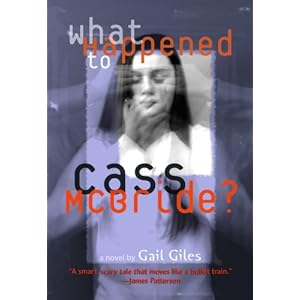
What happened to Cass McBride?

Summary:
Cass McBride is kidnapped and the main detective on the case is one of the alternating points of view. The story is told piece by piece as we (the readers) try to figure out what happened and how the characters got to where they are when the story begins.

Citation:
Giles, G. (2007). What happened to cass mcbride? Boston: Little, Brown.

Impressions:
I thought this was a great book. It was absolutely tragic book but it is good to show readers the severity of bullying and the violence that occur as a cause of it.

Review:
From School Library Journal
Grade 9 Up—Cass is that girl in high school who does whatever it takes to be popular-which means stomping all over everyone else. David is that awkward boy who painfully lurks on the outside of all of the social groups. When he commits suicide, his older brother is out for revenge against the girl whom he believes is responsible for David's death. Giles's characters are frighteningly believable. The story is part mystery, part psychological drama that involves dysfunctional families and abuse, and part crime investigation. It is told by Cass, her captor, and the police investigating her disappearance. Slowly, through these narrations, readers see what caused David's suicide and Kyle's anger and are given insight as to why Cass behaves as she does. This book will disturb readers, frighten them, and make them feel as though they are trapped like the characters. It is a thrilling, one-sitting read that they won't be able to put down.—Sherry Quinones Frederick County Public Libraries,  2010 (Retrieved from http://catalog.lapl.org/carlweb/jsp/DoSearch?databaseID=965&count=10&terms=what+happened+to+cass+mcbride&index=w)

Suggestions:
This would be a fantastic book on bullying and the seriousness that can occur at times.


Module 8

Module 8:
Impossible

Summary:
Impossible is about a 17 year old named Lucy who is raped at her prom and ultimately becomes pregnant. The entire story is based on the song “Scarborough Fair” in which Lucy finds out that she comes from a long line of cursed women. Lucy must break the curse before the birth of her daughter by performing three seemingly impossible tasks or she will go insane like all of her ancestors before her.

Citation:
Werlin, N. (2008). Impossible. New York: Dial Books.

Impressions:
This was a very unique book and I enjoyed reading it but a few of the elements of this book were a bit unbelievable. It’s great that Lucy was supported by not only her foster parents but also her best friend turned boyfriend. It was all a little too tidy though. Life is not that easy and you can’t always have your cake and eat it too. 

Review:
From School Library Journal
Starred Review. Grade 9 Up—Werlin combines magic, romance, and a family curse in this 21st-century fairy tale based on the ballad "Scarborough Fair." On the night of her prom, Lucy, 17, is raped by her date and becomes pregnant. She decides to keep the child, and she is supported by her foster parents and Zach, her childhood friend whose love for Lucy changes from platonic to romantic as the story progresses. The teen discovers the curse on the women in her family when she reads her birth mother's diary. Lucy is destined for madness at 18 unless she can perform the three impossible tasks described in the song and break the curse of the Elfin Knight. She is determined to rid herself and her unborn child of the curse, and her family and Zach help her as she works to solve the riddles. This unique story flows smoothly and evenly, and the well-drawn characters and subtle hints of magic early on allow readers to enter willingly into the world of fantasy. As in The Rules of Survival (Dial, 2006), Werlin addresses tough topics. Rape, teen pregnancy, and family madness set the story in motion, but the strength of Lucy's character and the love of her family and friends allow her to deal with such difficult matters and take on the impossible. Teens, especially young women, will enjoy this romantic fairy tale with modern trappings.—Jennifer D. Montgomery, Western Kentucky University, Bowling Green (Retrieved from http://www.amazon.com/Impossible-Nancy-Werlin/dp/0142414913/ref=sr_1_1?ie=UTF8&s=books&qid=1291956756&sr=1-1)


Suggestions:
I love the musical element of this novel. I think it would be great to include this book in a lesson about music in books and the unit could also include other simply books. Some other examples could be Shiver by Maggie Stiefvater or the recently book turned movie Nick and Norah’s Infinite Playlist.


Doll People
Summary:
Doll People is the first in a series of books about a Victorian dollhouse and the inhabiting family that has been passed down for generations. The Doll family get new neighbors after 100 years in the Palmer house and a new dollhouse family appear called the Funcrafts. The families ultimately join forces to find the Doll family’s precious Auntie Sarah who disappeared 45 years old.

Citation:
Martin, A. and Godwin, L. (2000). Doll people. New York: Hyperion Books for Children.

Review:
From Publishers Weekly
Passed down from one generation to the next, the Doll family has lived in the same dollhouse, located in the same room of the Palmer family's house, for 100 years. While the world outside has changed, their own lives have not with two significant exceptions. First, Auntie Sarah Doll suddenly and mysteriously disappeared 45 years ago, when the Doll family belonged to Kate Palmer's grandmother. More recently, the modern, plastic Funcraft family has moved into Kate's little sister's room. Following the time-honored traditions of such well-loved works as Rumer Godden's The Doll's House, The Mennyms by Sylvia Waugh and Pam Conrad's and Richard Egielski's The Tub People, Martin and Godwin inventively spin out their own variation on the perennially popular theme of toys who secretly come to life. By focusing on Annabelle's and Tiffany Funcraft's risky mission to find Auntie Sarah, the authors provide plenty of action and suspense, yet it is their skillfully crafted details about the dolls' personalities and daily routines that prove most memorable. Selznick's pencil illustrations cleverly capture the spark of life inhabiting the dolls' seemingly inanimate bodies. The contemporary draftsmanship frees the art from nostalgia even while the layout which presents the illustrations as standalone compositions as well as imaginatively integrated borders and vignettes reinforces the old-fashioned mood of the doll theme. Doll lovers may well approach their imaginative play with renewed enthusiasm and a sense of wonder after reading this fun-filled adventure. Ages 7-10. (Aug. 2000) Retrieved from http://www.amazon.com/Doll-People-Ann-M-Martin/dp/0786812400/ref=sr_1_1?s=books&ie=UTF8&qid=1291956892&sr=1-1)

Suggestions:
This a great book for elementary students to read just for fun. It is similar to today’s Toy Story movie series. As children we often wonder if our toys come to life when we aren’t looking and so this is a great book about such a question.

Module 7

Module 7:
Stargirl

Summary:
Stargirl is a unique girl who arrives at Mica High School and turns the whole school around.  She is the epitome of a nonconformist and after many strange looks from her peers they, too, begin to follow her lead. She begins to lose herself when she begins to date Leo Borlock and he suggests that she may be a little too odd.

Citation:
Spinelli, J. (2000). Stargirl. New York: Knopf.

Impressions:
This is a fantastic story about the troubles of middle school and high school and being an individual. I  love the nonconformity of Stargirl and how the author decides to end the story on a not so happily ever after note.

Review:
Amazon.com Review
"She was homeschooling gone amok." "She was an alien." "Her parents were circus acrobats." These are only a few of the theories concocted to explain Stargirl Caraway, a new 10th grader at Arizona's Mica Area High School who wears pioneer dresses and kimonos to school, strums a ukulele in the cafeteria, laughs when there are no jokes, and dances when there is no music. The whole school, not exactly a "hotbed of nonconformity," is stunned by her, including our 16-year-old narrator Leo Borlock: "She was elusive. She was today. She was tomorrow. She was the faintest scent of a cactus flower, the flitting shadow of an elf owl."
In time, incredulity gives way to out-and-out adoration as the student body finds itself helpless to resist Stargirl's wide-eyed charm, pure-spirited friendliness, and penchant for celebrating the achievements of others. In the ultimate high school symbol of acceptance, she is even recruited as a cheerleader. Popularity, of course, is a fragile and fleeting state, and bit by bit, Mica sours on their new idol. Why is Stargirl showing up at the funerals of strangers? Worse, why does she cheer for the opposing basketball teams? The growing hostility comes to a head when she is verbally flogged by resentful students on Leo's televised Hot Seat show in an episode that is too terrible to air. While the playful, chin-held-high Stargirl seems impervious to the shunning that ensues, Leo, who is in the throes of first love (and therefore scornfully deemed "Starboy"), is not made of such strong stuff: "I became angry. I resented having to choose. I refused to choose. I imagined my life without her and without them, and I didn't like it either way."
Jerry Spinelli, author of Newbery Medalist Maniac Magee, Newbery Honor Book Wringer, and many other excellent books for teens, elegantly and accurately captures the collective, not-always-pretty emotions of a high school microcosm in which individuality is pitted against conformity. Spinelli's Stargirl is a supernatural teen character--absolutely egoless, altruistic, in touch with life's primitive rhythms, meditative, untouched by popular culture, and supremely self-confident. It is the sensitive Leo whom readers will relate to as he grapples with who she is, who he is, who they are together as Stargirl and Starboy, and indeed, what it means to be a human being on a planet that is rich with wonders. (Ages 10 to 14) --Karin Snelson 
(Retrieved from  http://www.amazon.com/Stargirl-Readers-Circle-Jerry-Spinelli/dp/0440416779/ref=sr_1_1?s=books&ie=UTF8&qid=1291956218&sr=1-1)

Suggestions:
Once again this book would be great in a middle school or even lower high school level as it teaches them about something that they must deal with everyday. Do you choose the opinion of everyone around you or the people you care about and in turn care about you?


Speak

Summary:
Speak is young a teenage girl named Melinda who is starting her freshman year in high school after becoming a social pariah during the previous summer.

Citation:
Anderson, L. (2001). Speak. New York: Puffin Books.

Impressions:
Speak was a very moving story about a young girl’s struggle with dealing with the horror and consequences of rape.  Melinda struggles silently unsure about who to confide or what she should even be feeling. It’s is heart wrenching at times but the reader will be satisfied with the ending. It is also an excellent movie starring Kristen Stewart before her Twilight debut.

Review:
From Publishers Weekly
In a stunning first novel, Anderson uses keen observations and vivid imagery to pull readers into the head of an isolated teenager. Divided into the four marking periods of an academic year, the novel, narrated by Melinda Sordino, begins on her first day as a high school freshman. No one will sit with Melinda on the bus. At school, students call her names and harass her; her best friends from junior high scatter to different cliques and abandon her. Yet Anderson infuses the narrative with a wit that sustains the heroine through her pain and holds readers' empathy. A girl at a school pep rally offers an explanation of the heroine's pariah status when she confronts Melinda about calling the police at a summer party, resulting in several arrests. But readers do not learn why Melinda made the call until much later: a popular senior raped her that night and, because of her trauma, she barely speaks at all. Only through her work in art class, and with the support of a compassionate teacher there, does she begin to reach out to others and eventually find her voice. Through the first-person narration, the author makes Melinda's pain palpable: "I stand in the center aisle of the auditorium, a wounded zebra in a National Geographic special." Though the symbolism is sometimes heavy-handed, it is effective. The ending, in which her attacker comes after her once more, is the only part of the plot that feels forced. But the book's overall gritty realism and Melinda's hard-won metamorphosis will leave readers touched and inspired. Ages 12-up. (Oct. 1999) Retrieved from http://www.amazon.com/Speak-Laurie-Halse-Anderson/dp/0374371520/ref=tag_dpp_lp_edpp_ttl_in)
Suggestions:
This is an excellent for any young teenage girl to read as it ultimately proves that a person is never alone and suffering in silence is never the answer.


Module 6

Module 6:
The Year the Swallows Came Early

Summary:
This story is about a young girl named Eleanor but everyone calls her Groovy, who witnesses her father being arrested and must come to terms with her mother’s explanation of it.

Citation:
Fitzmaurice, K. (2009). The year the swallows came early. New York: Bowen Press

Impressions:
I really enjoyed reading this book. It was a beautiful story about family and forgiveness. It is also about growing up and the responsibilities that come with it.

Review:
From School Library Journal
Grade 4–7—Watching helplessly as her father is taken off to jail, Groovy Robinson, 11, is convinced that there has been a terrible mistake. When her mom admits that she turned him in because he gambled away the $25,000 savings account that Groovy's great-grandmother left her, the child shrinks into herself-disappointed, hurt, not caring about anything. Not until Groovy-now wanting to be known as Eleanor-heeds the advice of the homeless old sailor Mr. Tom does she grasp that people we love can hurt us, but that only through forgiveness can we become whole again. This first novel is peopled with three-dimensional characters whose imperfections make them believable and interesting. Groovy's big-talking, ne'er-do-well dad donates a trailer to Mr. Tom. Her beautician mom is guided by astrology, but her boundless love for Eleanor is totally grounded. And Groovy's perceptive friend Frankie is unable to grasp the real reasons that his immigrant mother left him in his stepbrother's care. The well-structured plot is underscored by clear writing and authentic dialogue, and short chapters keep the story moving. The book draws a parallel with the birds of Capistrano, and a novel that encourages understanding, tolerance, and forgiveness is as welcome as the returning swallows.—Nancy Menaldi-Scanlan, formerly at LaSalle Academy, Providence, RI (Retrieved from http://www.amazon.com/Year-Swallows-Came-Early/dp/0061624977/ref=sr_1_1?ie=UTF8&s=books&qid=1291956099&sr=1-1)

Suggestions:
This would a unique book to incorporate with a food unit. There is a recipe at the end of the book for Groovy’s homemade chocolate covered strawberries.

Module 5

Module 5:
A Bad Case of Stripes

Summary:
This book was a little girl named Camilla who always worried about what people thought about her. One day as she worries what she should wear to school that day he looks into the mirror to find herself covered in stripes. Nothing seems to cure her and Camilla only seems to make it worse until she realizes why such an odd occurrence happened.

Citation:
Shannon, D. (1998).  A bad case of stripes. New York: Blue Sky Press.

Impressions:
I thought this book was great. It was filled with great illustrations and a great moral lesson about being true to who you are. Most books about individuality can be trite sometimes but this book was fresh and funny.

Review:
School Library Journal
(c) Copyright 2010. Library Journals LLC, a wholly owned subsidiary of Media Source, Inc. No redistribution permitted.

K-Gr 2A highly original moral tale acquires mythic proportions when Camilla Cream worries too much about what others think of her and tries desperately to please everyone. First stripes, then stars and stripes, and finally anything anyone suggests (including tree limbs, feathers, and a tail) appear vividly all over her body. The solution: lima beans, loved by Camilla, but disdained for fear they'll promote unpopularity with her classmates. Shannon's exaggerated, surreal, full-color illustrations take advantage of shadow, light, and shifting perspective to show the girl's plight. Bordered pages barely contain the energy of the artwork; close-ups emphasize the remarkable characters that inhabit the tale. Sly humor lurks in the pictures, too. For example, in one double-page spread the Creams are besieged by the media including a crew from station WCKO. Despite probing by doctors and experts, it takes "an old woman who was just as plump and sweet as a strawberry" to help Camilla discover her true colors. Set in middle-class America, this very funny tale speaks to the challenge many kids face in choosing to act independently.Carolyn  Noah, Central Mass. Regional Library System, Worcester, MA, 2010. (Retrieved from http://catalog.lapl.org/carlweb/jsp/DoSearch?databaseID=965&count=10&terms=a+bad+case+of+stripes&index=w)

Suggestions:
This book would be great in an early elementary setting in a lesson about individuality and being yourself.


Module 4

Module 4:
The Giver

Summary:
This story is about a young boy named Jonas who appears to live in a perfect world. He lives in a controlled community where there seems to be no negative aspects of life. Everything changes when he is named the next Receiver and given the memories and past history of life. Jonas finds out a truth too shocking to ignore despite the dangerous choices he must make.

Citations:
Lowry, L. (1993). The giver. Boston: Houghton Mifflin.

Impressions:
Reviews:
loved this book. I had been meaning to read this book ever since I was in elementary but I never got around to it. Many of the elementary schools assign this book for class assignments. I thought it was an excellent dystopia. I am a big fan of dystopia and I thought this was a unique version of humanity.

School Library Journal
Copyright © Reed Business Information, a division of Reed Elsevier Inc. All rights reserved.

Gr 6-9-- In a complete departure from her other novels, Lowry has written an intriguing story set in a society that is uniformly run by a Committee of Elders. Twelve-year-old Jonas's confidence in his comfortable ``normal'' existence as a member of this well-ordered community is shaken when he is assigned his life's work as the Receiver. The Giver, who passes on to Jonas the burden of being the holder for the community of all memory ``back and back and back,'' teaches him the cost of living in an environment that is ``without color, pain, or past.'' The tension leading up to the Ceremony, in which children are promoted not to another grade but to another stage in their life, and the drama and responsibility of the sessions with The Giver are gripping. The final flight for survival is as riveting as it is inevitable. The author makes real abstract concepts, such as the meaning of a life in which there are virtually no choices to be made and no experiences with deep feelings. This tightly plotted story and its believable characters will stay with readers for a long time. --Amy Kellman, The Carnegie Library of Pittsburgh, 1993 (Retrieved from http://catalog.lapl.org/carlweb/jsp/PresentTitles?databaseID=965&index=n&terms=lowry%2C+lois&count=10&mapid=-1&refid=-1&tagid=-1&aid=-1&tagNum=-1&page=6&initialbrowse=null)

Suggestions:
This is one of my favorite books and I just recently discovered that is the first in a trilogy. I think this would be a great series to use in the class in order to compare different theories on the future and how it differs from the present or the past.


Jellicoe Road
Summary:
This young adult book is about a teenage girl named Taylor who was abandoned by her mother at a gas station when she was eleven years old. She now attends a boarding school and is the leader of the boarding schools six different houses. After her friend and closest thing she has to a mother disappears she discovers a book manuscript and begins to try to piece together the puzzle of her life and figure out why all of the people around her seem to be connected. 

Citations:
Marchetta, M. (2008).  Jellicoe road. New York: HarperTeen.

Impressions:
I really enjoyed reading this book. It was a little confusing at times as I tried to follow the two different stories going on in this book and trying to capture every clue.

Reviews:
Library Journal
(c) Copyright 2010. Library Journals LLC, a wholly owned subsidiary of Media Source, Inc. No redistribution permitted.

When she was 11, Taylor Markham was abandoned by her mother at a convenience store. At 17, she resides in a boarding school on Jellicoe Road. The closest person to her is Hannah, a nearby resident and would-be foster mom to the school's misfits. Now Hannah has disappeared when Taylor needs her most. She has been chosen to lead the school in its war with the local "Townies" and visiting "Cadets"-the cadets being led by a smoldering Jonah Briggs, with whom Taylor has a past. Looking for a clue to Hannah's whereabouts, Taylor reads a manuscript she left that tells the story of five friends united by a fatal accident on Jellicoe Road 22 years earlier. Why It is a Best: Set in rural Australia, the story of Taylor and of the five friends is permeated by a sense of place and time. Readers will smell the trees and taste the dust. Why It Is for Us: This is rich and layered domestic fiction that requires patience and careful attention as it spins a story of parents, children, and the legacy of tragedy. Readers of Anita Shreve and Wally Lamb will find much to enjoy here.-Angelina Benedetti, King Cty. Lib. Syst., WA. 2008. (Retrieved from http://catalog.lapl.org/carlweb/jsp/DoSearch?databaseID=965&initialsearch=true&count=10&finish=search_page.jsp&mode=manual&terms=jellicoe+road&index=w)

Suggestions:
This novel is very complicated at times but I think readers will be satisfied in the end. The entire novel takes place in Australia and it isn’t often that many youth fiction books take place in foreign countries. The language is different which could be an interesting method of introducing a foreign country that many teens don’t really think about very often.