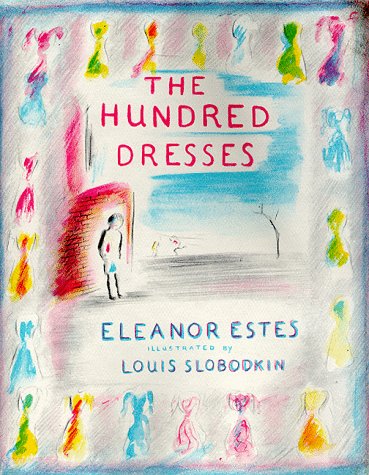
The Hundred Dresses
Summary:
This is a story of about a young, quiet Polish girl who is unknowingly teased by her classmates for being poor and different. She teaches them a lesson in kindness and not just simply about being tolerant.
Citations:
Estes, E. (1972). The hundred dresses. New York: Harcourt Brace Jovanovich.
Impressions:
I thought this was an excellent book. I almost cried which is saying a lot coming from me. It’s a beautiful story about kindness and forgiveness. I was a little scared though about Wanda’s absences. There were a couple pages there that I thought something bad happened to Wanda. Some of these books are a lot more mature than I feel is appropriate for the intended audience but I am not one to censor.
Reviews:
From School Library Journal
Grade 3-6-Friendship, peer pressure, regret, and courage are all issues that are integral to this Newbery Honor book by Eleanor Estes (Harcourt, 1944). Wanda Petronski tells classmates she has a hundred dresses of all varieties in her closet at home. So why does she always wear the same old worn dress to school? The teasing that follows seems harmless, but it's not. This book explores the hurt that comes from thoughtless words, and offers a painful, but heart-warming lesson in forgiveness. Christina Moore reads the unabridged story with warmth and expression. The author's carefully chosen words stand on their own without the distraction of sound effects or music. This is a well-done production of an exceptional book that has earned its place as a childhood classic.
Teresa Bateman, Brigadoon Elementary School, Federal Way, WA.1999, (Retrieved from http://www.amazon.ca/Hundred-Dresses-Eleanor-Estes/dp/0152052607).
Grade 3-6-Friendship, peer pressure, regret, and courage are all issues that are integral to this Newbery Honor book by Eleanor Estes (Harcourt, 1944). Wanda Petronski tells classmates she has a hundred dresses of all varieties in her closet at home. So why does she always wear the same old worn dress to school? The teasing that follows seems harmless, but it's not. This book explores the hurt that comes from thoughtless words, and offers a painful, but heart-warming lesson in forgiveness. Christina Moore reads the unabridged story with warmth and expression. The author's carefully chosen words stand on their own without the distraction of sound effects or music. This is a well-done production of an exceptional book that has earned its place as a childhood classic.
Teresa Bateman, Brigadoon Elementary School, Federal Way, WA.1999, (Retrieved from http://www.amazon.ca/Hundred-Dresses-Eleanor-Estes/dp/0152052607).
Suggestions:
I think this book could be used for younger ones. I think students of Pre-K or Kinder could definitely benefit from this story. A lot of times a child cannot fully understand the differences between people. Many times though children will surprise us and embrace them naturally. We do not want them to tolerant the differences in others or not see them but rather embrace them.
Summary:
This story is about a girl who seeks out the help of a talking rabbit in order to help her find the perfect present for her mother’s birthday.
Citations:
Zolotow, C. (1990). Mr .rabbit and the lovely present. New York: HarperCollins.
Impressions:
Honestly, I thought this story was a little odd. I found the illustrations disturbing at times and the storyline was monotone as well. It seemed too predictable and not very colorful at all. Naturally, it is very different from what is being published today. I also noticed that the book was originally published in Mexico which might explain the confusing and at times boring plotline. Sometimes stories can get lost in translation and their true meanings can be overlooked it. I may have missed something in the English version that I may have caught (and possibly enjoyed) in the Spanish version.
Reviews:
Amazon.com Review
Any collaborative effort by the esteemed Charlotte Zolotow and the illustrious Maurice Sendak is bound to be a success. These beloved creators of countless children's favorites outdo themselves with this 1963 Caldecott Honor-winning classic about a little girl in need of assistance. Finding a birthday present for her mother is no easy task for our heroine. Luckily, she happens upon the avuncular Mr. Rabbit, whose heart is in the right place, even if he doesn't always have the best ideas. Ultimately, his suggestions do come in handy, and between the two of them they determine the ideal birthday tribute: the gift of color. Children will join the protagonists in contemplating how to make the abstract tangible, and all readers will be delighted to see yellow translate to bananas, as green is given in pears, and blue takes the shape of grapes.
The soft, muted colors of Sendak's illustrations are reminiscent of a Monet landscape--utterly appealing and dreamy. And the reflective, sing-song dialogue between Mr. Rabbit and the girl is as deliciously lulling as a shady swing in a hammock. This quiet, peaceful book is a treasure for any shelf. (Ages 4 to 8) (Retrieved from http://www.amazon.ca/Rabbit-Lovely-Present-Maurice-Sendak/dp/0006640850/ref=sr_1_2?ie=UTF8&s=books&qid=1291872271&sr=1-2)
Suggestions:
I really did not like this book at all. It was repetitive and did help to inform the reader on the different colors. It might a nice book for teaching children on the joy of giving presents and learning what colors different ordinary objects are as well.


